A link to an article in The Age, about 2 weeks ago - some of you may have seen it.
http://www.theage.com.au/national/going-home-the-great-aboriginal-dream-20130712-2pvj0.html
It was interesting for us to read this article while we're here! Quite a few people have talked about Perrederr being their country. There's a lot of talk about country at the moment; I think it's because of the season, and "bush holiday" and people wanting to be "out bush", or just "bush". So, a patient today said she couldn't come for a blood test on Monday, because she'd be out bush. Fair enough. She feels well, and the kidney specialist wants her to have all these tests.. what's the hurry? From my point of view, only that the specialist is coming back next week, and it'd be good to have the tests done. But this is my priority, not hers, and I can certainly see it from her point of view, and understand her greater need to be in her country.
Friday, 26 July 2013

Monday, 22 July 2013
Weekends with a difference
Our "normal" weekends here are quiet and restful. I like to wander out with binoculars after a reasonably early breakfast, suitably coated with toxic chemicals, and look at birds (must wear shoes and socks next time - I didn't like ants crawling in the gaps of the sandals). When it gets too hot, head for home, then out to the women's centre for a coffee and chat with whoever's there, then a swim! The rest of the weekend is quiet. Moving the sprinkler, reading, maybe a DVD, maybe a walk on the beach to watch the sunset, sometimes a BBQ as well.
We quite enjoy the quiet pace. Very restful, and a contrast from home. However, the last two have been rather different!
 Mid July, Andy turned 30! So we went in to Darwin on Friday after work. Andy, Cathy, Georgi and Isabel had travelled in from Nhulunbuy the day before, and settled in to the apartment. And Rikky flew up from freezing Melbourne on Friday too! It was so good to all be together to celebrate, and just catch up. Tim and I were able to meet up with Dave & Julie Pugh/ U'Ren, Rikky met an old classmate who's in Darwin, and Andy did a tandem skydive (birthday present from Cathy!).
Then yesterday, I went "out bush" for a picnic with Lis, a part time, long term doctor here, and 8 of the older women. One of them is one of the traditional owners of the place we went to - a beach site, accessible by 4WD (Lis drove one car, I drove the other - sliding along sandy tracks was a bit out of my comfort zone. Lis's advice: just don't stop. The women in my car said: it's ok, you won't get bogged..)
It was a fabulous day. Stephanie in my car played music on her phone: one minute, a funeral song for her cousin - "it's about his country, that's my mother's country." And when a bird song sounded, "That's his dreaming." Next song, "Hey Jude".
A fire was going in no time, we had tea, and food Lis had prepared. Then half of us went looking for longbums (pronounced longboms... I had thought that was a language word, but it's English - I wonder if it means they have a very long tail.. ). They are "ku thaali" in Murrinpatha, and are shellfish in a conical shell, found in the mangroves at low tide.
 The mangroves! You could easily get lost in there! It's like a forest, with the added complication of mud up to the ankles (or more) and the round mangrove shoots sticking up everywhere - bit hard on the soft feet of this white woman. I really appreciated how the others looked after me, telling me what to do, calling me to keep coming, and explaining what to do.
We collected firewood close to the car, and on getting back to the others, sat round the rekindled fire and cooked the longbums -
 just throw them on and stir with a stick. How can you tell when they're done? "The bubbles come out, then the head comes out!" Then, just move them out of the fire, and when cool enough to eat, hit them (often with another one) to break them open and pull out the creature. It's green! But don't eat too much of it's "long bum" - "you might get diarrhoea". I tried one, it was good.
 We packed up and drove towards home - along the sand dunes - tried fishing at the gas plant landing. Some of the older women wanted to go home, so Lis took them, and I stayed with the others. The 5 of us caught one fish, and a very small one at that (not sure if it went back in, or not). From there, we headed home.
What a great day! I came back tired and very dirty, with a few minor scratches, but no bites and no sunburn. I loved listening to the women talking in Murrinpatha (but wish I could understand it!) - and so appreciated how they explained things to me and chatted. Lis sometimes organises an overnight camp with them - now that would be fun...
We quite enjoy the quiet pace. Very restful, and a contrast from home. However, the last two have been rather different!
 Mid July, Andy turned 30! So we went in to Darwin on Friday after work. Andy, Cathy, Georgi and Isabel had travelled in from Nhulunbuy the day before, and settled in to the apartment. And Rikky flew up from freezing Melbourne on Friday too! It was so good to all be together to celebrate, and just catch up. Tim and I were able to meet up with Dave & Julie Pugh/ U'Ren, Rikky met an old classmate who's in Darwin, and Andy did a tandem skydive (birthday present from Cathy!).
Then yesterday, I went "out bush" for a picnic with Lis, a part time, long term doctor here, and 8 of the older women. One of them is one of the traditional owners of the place we went to - a beach site, accessible by 4WD (Lis drove one car, I drove the other - sliding along sandy tracks was a bit out of my comfort zone. Lis's advice: just don't stop. The women in my car said: it's ok, you won't get bogged..)
It was a fabulous day. Stephanie in my car played music on her phone: one minute, a funeral song for her cousin - "it's about his country, that's my mother's country." And when a bird song sounded, "That's his dreaming." Next song, "Hey Jude".
A fire was going in no time, we had tea, and food Lis had prepared. Then half of us went looking for longbums (pronounced longboms... I had thought that was a language word, but it's English - I wonder if it means they have a very long tail.. ). They are "ku thaali" in Murrinpatha, and are shellfish in a conical shell, found in the mangroves at low tide.
 The mangroves! You could easily get lost in there! It's like a forest, with the added complication of mud up to the ankles (or more) and the round mangrove shoots sticking up everywhere - bit hard on the soft feet of this white woman. I really appreciated how the others looked after me, telling me what to do, calling me to keep coming, and explaining what to do.
We collected firewood close to the car, and on getting back to the others, sat round the rekindled fire and cooked the longbums -


What a great day! I came back tired and very dirty, with a few minor scratches, but no bites and no sunburn. I loved listening to the women talking in Murrinpatha (but wish I could understand it!) - and so appreciated how they explained things to me and chatted. Lis sometimes organises an overnight camp with them - now that would be fun...
Monday, 8 July 2013
On being familiar
Familiarity breeds contempt.
Did you learn that at school as well?
I don’t reckon it’s true. Back in
Wadeye for the third time has been wonderful.
Feeling that everything isn’t strange, understanding a bit of the
system, it’s all good. But the best is
when a local say’s “You’re back”, with a bit of a grin.
The house is familiar – the light that doesn’t come on straight
away, the louvre that doesn’t close properly and the rush to get the dishes
done before the water drains out. We had
patients to see as soon as we arrived.
On the first day, a lady rushed into my consulting room. She had a big smile, and told me about her
family. The fact that she wanted to sell
me a painting didn’t really detract. It
is good to be back.
Probably the most enthusiastic about us being here is the
Culiocoides family – better known as the midges or sandflies. They have celebrated in style...

This is a bit representative, and I'm not going to reveal all. You could make a loud sympathetic sigh at this point. But it's got me thinking. I'm more of less used to it now, and that helps me understand some issues of health care here.
I've been wondering what happens to people who live here all the time. The locals live with midges, scabies, nasty bacteria and the rest. That's life. Why would you go to the clinic with skin sores. They're a part of life that won't go away. It hasn't occurred to me to see someone about my itches. But they're not really that bad, and I have some idea of what can be done and what can't.
The hardest part of our first week is feeling that there is reasonably good provision of health care but terrible implementation. Bad skin infections have made diabetes control out of control, back aches have caused misery and poor mobility. We have cleverly given medicines and even packed them in dosette boxes. We have documented the ways we are dealing with the problems. But only to find at the end of the week that the medicines are untouched and the problems are worse.
Today I gave some antibiotics to a family member of a child who was bitten by a dog. I explained how to give them. She then asked me what they were for. I had made all sorts of assumptions. People do want to understand, and I am understanding slowly that unless I can engage at that point, there is a lot of wasted energy.
There are some good things going on here. We have heard an estimate of 650 people with jobs - not bad in a community of 3,000+. Education provision seems more flexible and relevant. There's a good feeling in town. It may be that it's bush holiday time, but I think there is more. I just wish for a health care system owned and operated by locals.
Wadeye 2013
We are in Wadeye for a 5 week placement. It's good to be back - it feels like coming home! I appreciate many things about this place: the bush, the birds, natural beauty. It's good to renew connections with people too. There are many familiar faces, and some remember us.
There's a cardiology clinic this coming Tuesday (tomorrow), and I was again given some responsibility for checking people with RHD - rheumatic heart disease, now so rare in mainstream medicine, but so devastating to people here. RHD is one of the symbols of "The Gap" which needs to be closed. It's a disease resulting from many infections over a long time, and episodes of acute rheumatic fever where the heart is damaged. Patients diagnosed with this condition need to have a monthly injection of long acting penicillin, to prevent further attacks. Some seem to understand, and have their injections monthly. Many avoid the injections, and I wonder why this is, when so much is at stake. I wonder if "we" have failed in the process of communicating what it's all about. On Tuesday, Felicity, the RHD support nurse, will be here from Darwin. I hope there's time to talk with her about these issues.
One of the factors is the turnover of the team - so patients often have a new nurse to get to know. There are only 2 nurses here now, who were here last year. They were also here the year before - so this is some continuity, at least. One of them works as a midwife in antenatal care, the other is now managing the chronic disease program and networking with other agencies working here. A big job.
And the team is about to turn over again - in 2 weeks one will be back from leave (oh yes, she was here last year), but everyone else will be new.
Apart from catching up with people with RHD, I have a long list of people with chronic disease who are overdue GP checks. So I have plenty to do! And not enough time to do it in! We're here for 5 weeks, which is really just a drop in the ocean. We'd like to make a difference here, even if it's in the lives of a few people, rather than impressive results.
On another note, the swimming pool is open from 7-8am for laps. Work starts at 8, so it's a bit of a scramble, but I've been enjoying a morning swim.
Saturday, 4 August 2012
snippets
While out doing home visits: young children in the family were playing with a hairless joey they'd had since the day before. Leanne, a RAN (remote area nurse), took it to the rangers, while I waited with Rosemary, a RAN back here to be the chronic disease coordinator. It may be too young to survive, but the family had no bottle or syringe.
Rosemary knows the community well, and it's great she's back. She and Kirsty, another RAN, have been coming for many years. The team is about to change dramatically, as at least 5 RANs are leaving withing a few weeks. Continuity is so important here, but so hard to maintain.
The fruit and veggie shop didn't open on Tuesday (the day the fresh supplies come in) - "not enough staff"
Last Friday (27th July) was a public holiday for Royal Darwin Show day. We weren't required to work, so we drove to Daly River. Some of you may have been there. We stayed in a caravan park right on the river. We'd arranged to meet up with Nick & Rosie & family - they were on their way to Broome. We had a great time catching up with them, and we also caught 2 freshwater sharks! Enough to feed us all. Daly River is on the road to Wadeye. So we came from the west, and the others came in from the east.
We brought a sprouting coconut back from Daly River, hoping it might grow in the garden.
Going out of the clinic one night after work, we met a lady. She told us that her husband had passed away a few months ago, and she felt lonely, so she would pray. She said she was the designer and printer of the material I'd bought from the women's centre, and the money from the sale would help her when she goes to Darwin for an operation. It was good to sit and chat.
Not a drop of rain during our time in Wadeye! We're back in cold Victoria now, having left yesterday. I'd hoped we'd have time on our last day to be a bit relaxed, saying goodbyes etc. But it was a busy medical day, starting off with a really sick baby who Tim was involved with, intraosseous fluid resuscitation and then transfer (a similarly acidotic child had died in the clinic a few weeks back, before we arrived). Then in the afternoon, I helped organise the transfer of two patients with serious infections, one a wound on his foot, that had been discharging for months, the other probably had a foreign body in his foot. All the plane seats were taken, it being another long weekend (NT Picnic Day this time) so a special charter came for them.
We've been thinking about The Invervention, and Stronger Futures.. those thoughts are not quick snippets! The issues are not simple, and we see many aspects to it all. Hopefully the subject of another post.
As the call came over the clinic PA, "The car is ready to go to the airport," we gathered with the staff. One of the RANs is a Zulu. She got us to hold hands, and she sang the 23rd Psalm. It was very moving, and a lovely send off. We're sad to leave. We feel that we've been able to build on last year's experience, and also continue some relationships. We hope to be back some time!
It's great to be home now, despite the temperature. It's special to see family again (what lovely smiles Isabel gave us, and what fun with Georgi!). We have a week before starting back at work here.
Tuesday, 31 July 2012
RHD
RHD... Rheumatic Heart Disease. I've been given the job of reviewing these patients, in preparation for the cardiologist's visit in October. Many of you (those a bit older - say no more) will remember rheumatic fever, and how it can affect the heart. It's not common in mainstream medicine, but is a reality here, as people have many streptococcal infections and some develop rheumatic fever. They then require a monthly injection of long acting penicillin, to prevent recurrences which may make the heart effects worse. The team here have found that it's sometimes easier for them to go out and see the people in their homes.
Reviewing the patients has pushed me out of the comfort of the ivory-tower clinic. I've taken the nurses' maps of the community and driven round the streets, stopping at the relevant houses and asking if the person is there, then sitting on the verandah or the tiled floor inside, and doing a check up. I've found people generally helpful and welcoming, and I've had some good times with them. Sometimes I've needed to go back to a home several times before I connect with the person concerned. I've realised that people have their English name, that we know them by, and they also have a name in their language, that they call each other by. They all know the English names as well. It's another example of how much the people need to know, in order to work within systems that are so white-mainstream-western.
Anyway, we leave on Friday, and I'm not sure I'll have seen everyone I need to. That's chronic disease - the work goes on and doesn't finish. I'll be able to leave a list for Dr Simon to follow up. It's good to know that he's here 3 days a week, working with chronic disease patients. This week, Rosemary came back. She's been coming for 10 years. She's come back to be the chronic disease coordinator.
Meanwhile, Tim has been working on the acute side. Hopefully he'll write something!
Sunday, 15 July 2012
Hope?
I've just finished reading "Listening to Country" by Ros Moriarty. I highly recommend it! I found it inspiring and very moving. I wonder, is there hope?
 Briefly:
Ros is a white woman who married John Moriarty, a man from Borroloola, who was stolen from his family, and reconnected much later. She describes the journey of connection with family, traditional Law and culture, and what it means that the young people haven't wanted to embrace the traditions. She describes richness of family life in the midst of poverty and the gradual but inexorable breakdown of culture. Interwoven with this story is the story of their family life and their business, Balarinji, now an international design agency, with well known Indigenous designs - the painted Qantas planes, for example.
As a newcomer here in Wadeye, a different community, I can only guess how the principles apply here. But - it does seem that traditional culture isn't strong in the town here.
I'm struggling to see how Indigenous cultures can flourish and progress in the context of white/mainstream/dominant culture, which sets the agendas and the rules. Is it possible for these two cultures to live side by side with mutual respect, and openness to the other?
Is it too late to undo the damage of European settlement and takeover?
Andy sent us a link to an article suggesting that we, the white community, need to become powerless, in order to make a difference, to allow Indigenous people to develop appropriate community programs.
http://blog.whywarriors.com.au/2012/letting-go-of-our-power/
It makes interesting reading. Is this a hopeful way forward? To trust Indigenous leadership enough, and to take a supportive role?
Ros Moriarty says, "Talk is cheap and words and symbolic gestures, while vital to the effort, will ring true only when we write a new Australian story that is scripted for John's family as well as mine. Pragmatism and empathy in balance might begin to turn the tide."
In the meantime, we are here in Wadeye, doing a medical job as part of a clinic team. I hope that as we go about it, we communicate respect - and I hope we empower people in their health. That's our goal in mainstream Leongatha medicine! It's not always easy there! So spare us a thought, and write them down!
Briefly:Ros is a white woman who married John Moriarty, a man from Borroloola, who was stolen from his family, and reconnected much later. She describes the journey of connection with family, traditional Law and culture, and what it means that the young people haven't wanted to embrace the traditions. She describes richness of family life in the midst of poverty and the gradual but inexorable breakdown of culture. Interwoven with this story is the story of their family life and their business, Balarinji, now an international design agency, with well known Indigenous designs - the painted Qantas planes, for example.
As a newcomer here in Wadeye, a different community, I can only guess how the principles apply here. But - it does seem that traditional culture isn't strong in the town here.
I'm struggling to see how Indigenous cultures can flourish and progress in the context of white/mainstream/dominant culture, which sets the agendas and the rules. Is it possible for these two cultures to live side by side with mutual respect, and openness to the other?
Is it too late to undo the damage of European settlement and takeover?
Andy sent us a link to an article suggesting that we, the white community, need to become powerless, in order to make a difference, to allow Indigenous people to develop appropriate community programs.
http://blog.whywarriors.com.au/2012/letting-go-of-our-power/
It makes interesting reading. Is this a hopeful way forward? To trust Indigenous leadership enough, and to take a supportive role?
Ros Moriarty says, "Talk is cheap and words and symbolic gestures, while vital to the effort, will ring true only when we write a new Australian story that is scripted for John's family as well as mine. Pragmatism and empathy in balance might begin to turn the tide."
In the meantime, we are here in Wadeye, doing a medical job as part of a clinic team. I hope that as we go about it, we communicate respect - and I hope we empower people in their health. That's our goal in mainstream Leongatha medicine! It's not always easy there! So spare us a thought, and write them down!
Thursday, 12 July 2012
When is obsessional, well...obsessional?
Like Joy said, it's good to be back. I'd forgotten the dogs though! They don't sleep, and sometimes it seems that no-one else does as well... They really do howl when there is a full moon. Despite them, we are feeling like this is home for this brief time and are very happy here.
The dogs remind me about "Jack". He was the first indigenous patient I met last time we were here. He sticks in my mind - a big, broad, healthy looking man with a bad cough. We arranged for him to be checked in Darwin. Sadly, his chest XRay showed a nasty cancer. I asked about him this time. Apparently his health declined quickly. Back for a while in Darwin, but no useful treatment available. The staff told me with some emotion about his return. He was loaded in Darwin onto the Careflight plane unconscious for his trip home and palliative care. The plane landed at dusk. A few minutes later, there were people everywhere waiting respectfully, some quiet, some crying. No-one quite understood how everyone knew to come. Somehow they just did, as if they had a sense that he was coming home. And even his dogs and a lot of other dogs came and sat on the tarmac while he was unloaded. Even though he wasn't responsive, a nurse said "Jack, welcome home". To her amazement, tears ran down his face. Five hours later he passed away.
Not all the stories are sad. It has been wonderful to be able to talk and laugh with local people we remember from last year.
The first morning we were late to work. Only 3 minutes, but the 8 am team meeting was well underway. Oops! That and a myriad of daily events highlights to us the challenges of running a health service here. Rigidity about rules concerning time in a cultural context that sees time very differently is tricky. Sometimes it feels that the more local people seem relaxed about the clock, the more white people live by it. But not just time. Our program is vast and complex. There are numerous health plans, care plans, review checks, consultant recalls, and complex audits of them all.
Overlying that is Medicare. Our health system was not designed with the Northern Territory in mind. I guess that makes sense. Only 200,000 people live here. While my brain is barely coping with what care plan to do when, I have to remember whether the medicare number is a 715, 732, plus a 23 or 36 plus a 10991 incentive item, or perhaps a 721 or 723 bearing in mind that the last 2 can only be done once in 12 months, the 715 once in 9 months, or it could be a 703 or a 705, plus a number relating to other services given.
Last time, we commented on the lack of Indigenous Health Practitioners. That hasn't changed. Maybe we should scrap the clinic and have a yarn with people under the nearby gumtree. Would that change our impact? We certainly wouldn't be able to get the care plans done! Is it realistic to expect local people to come to work at 7.55am, sit in an office and share the consultation with a patient and a computer screen?
Having said all that, I'm sure we are helping. I met a teenager this week who talked about his family. His cousin plays football at an elite level in Darwin. He's pretty proud of him. This bloke can't do that. He had rheumatic fever when he was 10, and already has significant heart problems. He inspired us to want to do all that we could to prevent this sort of disease. And there are lots of good things happening. Some great strategies for health, good care of people of all ages, and really caring people doing it. It has to be worthwhile... But maybe being obsessional isn't always the answer.

A CareFlight arriving to take someone to Darwin for treatment
Tuesday, 10 July 2012
Back in Wadeye
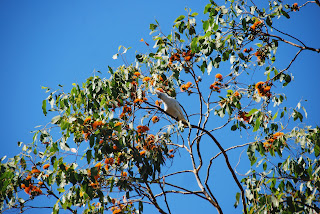
We've been here a week. It's good to be back: so much is familiar. We're earlier in the season this time, and some of the gums are flowering, stunning orange blossoms. Little corellas screech and nip off the buds. It's been cooler overnight - rather nice. (but it's all relative)
 We have 5 weeks here this time. It was great to have a week in NT before starting - we hired s campervan and enjoyed Litchfield National Park & Berry Springs, especially the chance to join with Tim's brother Nick and his family for Nick's 40th. Jerry came up as well. What a great time! Nick & Rosie looked after us really well, and how their 4 have grown! It was special to renew connections. Josh is into fishing, Matt is always seeing birds before anyone else and knows what they are! Zach loves crocodiles (not quite sure why), and Abbey makes friends wherever she goes.
 So back to Wadeye. Some of the staff are the same, and also we new ones to meet. The team seem to be working well together, and morale is good. Saturday night we cheered for the clinic at a basketball game, Clinic vs Police - clinic lost, but tried hard! We had a BBQ together afterwards.
There are still no indigenous health workers, and I miss the opportunities this would bring: help with understanding people's issues, and help in explaining medical concepts of disease and treatment. This is important in all our work at the clinic, and I'm very aware of it - I'm working in chronic disease again this year, and I often feel the lack of communication skills. Part of it is basic language difficulties, but I know there's more to it. I'm still not sure how to "do" chronic disease, especially as I'm so short term. I feel humbled when people share their lives with me - it feels like an unexpected gift.
It's good to be back. We hope our being here is worthwhile for team and community. We appreciate the opportunity to slow down a bit in the work context, even though there are busy patches. We appreciate the working day finishing earlier, and evenings without the usual demands of home. We appreciate the beauty of the bush around us. We had a great walk on the beach at sunset last night, with some others from here.
So we will post!

 We have 5 weeks here this time. It was great to have a week in NT before starting - we hired s campervan and enjoyed Litchfield National Park & Berry Springs, especially the chance to join with Tim's brother Nick and his family for Nick's 40th. Jerry came up as well. What a great time! Nick & Rosie looked after us really well, and how their 4 have grown! It was special to renew connections. Josh is into fishing, Matt is always seeing birds before anyone else and knows what they are! Zach loves crocodiles (not quite sure why), and Abbey makes friends wherever she goes.

There are still no indigenous health workers, and I miss the opportunities this would bring: help with understanding people's issues, and help in explaining medical concepts of disease and treatment. This is important in all our work at the clinic, and I'm very aware of it - I'm working in chronic disease again this year, and I often feel the lack of communication skills. Part of it is basic language difficulties, but I know there's more to it. I'm still not sure how to "do" chronic disease, especially as I'm so short term. I feel humbled when people share their lives with me - it feels like an unexpected gift.
It's good to be back. We hope our being here is worthwhile for team and community. We appreciate the opportunity to slow down a bit in the work context, even though there are busy patches. We appreciate the working day finishing earlier, and evenings without the usual demands of home. We appreciate the beauty of the bush around us. We had a great walk on the beach at sunset last night, with some others from here.
So we will post!
 |
| the dry season burn |

Friday, 9 September 2011
The End
Times up ... well almost. There's still a bit to do before we fly out. I'm going on an outstation visit to Fossil Head. Joy will scratch at the mountain of yet-to-do health reviews and management plans.
It's Stuart's last day as well. He has been the clinic manager as well as a Remote Area Nurse for the last year or so. He's open about it being a tough time, and he's ready to go. We've looked around at the other staff here who we have got to know, but really hardly know at all. For some, the crusty exterior protects against the all too frequent coming and going of new staff. There are ideas about how to increase ownership by local people, but no-one really knows how to implement them. It's particularly hard when the wage for a Health Worker is much the same as the unemployment payments. It doesn't even seem to be clear where the policies and directions for the clinic and health work here are made.
We're sad to leave. This has been a rich and challenging experience.
We are already planning our next locum here. Wadeye has got under our skin.
Tuesday, 6 September 2011
The Long Grass
We'd never heard about going long grass before coming here. It's a colloquial term meaning absconding to drink grog. People stay in the long grass. In a dry community, it's a real issue for those going to Darwin. It's a big temptation to have a few drinks...
Do you remember "Bruce"? He has been sick, mostly because he has had rheumatic fever in the past, and a heart affected by alcohol over the years. He has been struggling. His younger brother came to see me about him. This brother is a big bloke, and has a commanding presence. He has been able to avoid grog, and felt so strongly as a 23 year old, nicked a front end loader from the shire depot and bulldozed the back of the pub. (The shell of the pub still stands - the ultimate pub with no beer.) This brother's advice was that Bruce would find a trip to Darwin a strong call to the long grass.
But what to do? His blood tests suggested a heart attack, and we needed to know what was going on. Lots of talk later, he did go, and managed for a while. Last Thursday he wasn't in the ward that he was meant to be in, and was no where to be found.
Bruce's wife is delightful. She has been dropping in a couple of times each day, anxious that I might be upset with him. She suggested a family meeting. "OK, 11am on Tuesday."
Today at about 10.45, she came in saying there was a mob outside for the meeting. With one of the nurses, I sat with 20-25, mostly women and children. We took over the education room. Two blokes sat at the side. It was a fun time of talk, laughs and a few tears. Most of the talk was MurrinhPatha. One bloke wandered in at 11, annoyed that no-one woke him up in time. We decided together that we would look after "Bruce" the best we could in Wadeye. After about 30 minutes of talk, something happened and everyone got up and left.
I asked later what was the talk about the meeting. Apparently they think that "Bruce" must have cancer! How did that happen? I guess I have a bit to learn!
And "Bruce"? He was found today and is back in hospital. I think.
Sunday, 4 September 2011
Old Mission, and Nimbi beach
Yesterday we explored some more. It's been great to have the use of one of the clinic cars after hours (it's used for clinic work during the day and we keep it at our place overnight and weekends). So 5 of us went out- we took Dan (med student) and a couple who've just come back after 2 years away. They lived here long enough to learn some MurinhPatha and make some significant relationships.
They took us to Old Mission, which is a small outstation on the beach. We sat under a tree with the traditional owners Anthony and Benigna, some kids, a cat and dogs. Anthony told with great enjoyment a story of some Indonesian fishermen who landed on his beach looking lost: "What island is this?". "Australia" was met with disbelief. They told stories of the mission's early days on that site. There's a pure white memorial statue of Mary and baby Jesus, reminding visitors of the strong Catholic involvement. Benigna is very devout, and has one room in her house as a dedicated prayer room. We wandered on the beach, then drove along to Nimbi, looking for nautilus shells along the way.
Tim is doing great at 4 wheel driving! It was amazing driving along the beach - low tide, a big expanse of firm sand. A creek to cross (I missed the photo unfortunately, but took another of a smaller creek). Nimbi is not far from our other beach BBQ spots: round the point and sheltered. It's a beautiful bush setting, and there's even a picnic table! We had a great walk across the tidal wet sand, and enjoyed a BBQ and chat. Brin is working as a RAN (remote area nurse) again, and Sarah, also a RAN, is doing a PhD about traditional birth practices. It was quite dark when we left, and the tide coming in. We drove home on bush tracks, connecting with the "main" road to the beach.


Saturday, 3 September 2011
The Town of Wadeye
The buildup is starting. Last week the Top End had its hottest days this year. Everything is dry. No-one talks about the weather here, as each day is the same. Well, almost. People are starting to think towards the wet season. There's lots to do before then. Travel by car is impossible from November. All the flat areas will apparently be under water. Hard to imagine at the minute. The red dust, dry grass and more dust tell another story.
Wadeye (the locals say "wod-air" ) has a reputation. Like anything, no-one notices this part of the world until there is a Problem. Sadly, the reports of the last 10 years have been stories of unrest, intervention, failed policies and unfavourable statistics. That's not what we have seen though. There is still Judas Priest and Evil Warriors graffiti, reminding residents of high tension, particularly between the two gangs styled on heavy metal rock bands. While there might be unrest around the fringes, there are lots of positives happening that don't get reported.
It must have been tough at times. If you are interested, a good article to read is:
It must have been tough at times. If you are interested, a good article to read is:
http://www.theaustralian.com.au/news/features/a-town-like-wadeye/story-e6frg8h6-1111114787006
We have heard stories of the fights on the footy oval condoned and even arranged to relieve tension. After an 18 year old was shot by the police in 2002, troubles have flared at times. The clinic nurses who have been around for a while tell stories of evacuations of all the white people, being confined to their houses, and frightening experiences like trying to drive the ambulance and being surrounded by 200 -300 people jostling the vehicle. They have learnt that if the women and children go bush, they need to be alert. We have heard from one person who counts 7 break-ins in to her home during her time here.
With all of that, each day has given a glimpse of another picture. The way the community cares for an unpredictably psychotic man, the depth of feeling when a diagnosis of cancer comes back from the Royal Darwin Hospital, the tolerance of locals of white people representing a dominant and sometimes demanding culture. We have spent time with one white couple who never lock their house and have never had a problem. Yesterday we met Boniface Perdjit. He is a Traditional Owner of the local area, and is Australia's first married Catholic deacon. He's a gentle, wise man who mirrors peace with a twinkle in his eye. One hardened white fella said of him that Boniface's brand of religion is almost enough to make him follow Jesus' teachings.
We are recognising people enough to have a yarn outside the store or in the street. We're still not exactly sure what the role of doctors should be, but we are glad we are here.
Friday, 2 September 2011
Friday snippets
I'm sad to report that the yoghurt took 24 hours to set this week. But at least it set..
It's been a funny day today, yesterday too - the clinic has been really quiet. Lots of people have gone to Daly River for the Daly River festival. More dodgem cars, music. It's probably good the clinic was quiet - we've had computer problems for the last 2 days, needing to log off frequently for re-setting the password. It's hard to get 8 or more clinicians to log off at once! "Just finish what you're doing and LOG OFF". It seems to be sorted now.
I've been able to finish the health assessments at the aged care home, where "Mary" lives. I've really enjoyed getting to know these women with so much life experience, so different from mine. One can hardly speak, but is able to communicate by slight head movements, and smiles. It's lovely to see the staff care for her so well, and her family too. Another lady is 95, and the mother of the traditional owner of the area here (Wadeye, and also Air Force Hill). We met him yesterday. He's a wise and caring man, carrying quite a load of responsibility. "Mary" is still alive, but seems to be deteriorating.
We're looking forward to the weekend, and planning more exploring, hoping to repeat the damper & BBQ. No swimming though: Tim heard from someone that nowhere's safe... glad we didn't know that last weekend! We'll walk on the beach with great care & eyes peeled for crocs.
The countryside is very dry, and grass in our own yard looked almost dead. But it's amazing how it's become green after a couple of days of watering.. there's lots of water here, and sprinklers are going all the time. It keeps the dust down too. Watering the lawn has been another adjustment.
Monday, 29 August 2011
Local health
Today I met "Jean". Her back hurt, especially after travelling to Wadeye yesterday over the bumpy, corrugated roads. She has a disc problem in the lower back, hard enough to treat in mainstream healthcare.
She's in her 70's. Her place is 2 hours drive from here. She comes here because this is her husband's country. She looked at me out of the corners of her eyes. "Do you wanna see my country?" I wasn't sure what was coming next, but she pulled out her mobile phone. We looked at more than 70 photos of a beautiful costal bush, deserted beaches and pristine waterholes. "See the pig in that picture?" I asked whether she caught it. "Nah, all we had was stones. We gave it a fright though!" One photo was a big rocky cliff. "See the heads? There's the man and there's the woman." She said with a look of disgust that her ancestors never told them how they got there. Another photo was a grassy spur pointing out to the beach. "What do you reckon that is?" I didn't know but thought it looked like a crocodile. "Nah, it's a swordfish". She then told me the story about how the fish got tired and lay down to sleep and never woke up. There was something quite incredible about hearing some ancient wisdom and story via a fluorescent orange Nokia.
"Bruce" is 61. He's very dignified, with a bushy crop of grey hair. He shares a common problem here. He had rheumatic fever as a child, has diabetes and kidney disease. He came in late a few days ago with chest pains. The tests were normal. He came in with his wife this morning, still not feeling great. I asked about drinking. That set off a lot of animated conversation in the Murrinh-Patha. He smiled a bit ruefully. "She said to be honest". We jigged his tablets and he'll come in tomorrow (hopefully). I've just had a phone call from pathology in Darwin (it's 8pm) to say that the blood sent today on the plane shows that he actually did have a heart attack. What to do? To send someone to Darwin for care often means that the temptation to abscond and look for grog is strong. I don't even know how I would find him at night.
We're slowly finding out that there is more and more that we don't know. The medical challenges are ... challenging! Today a wound culture came back with diphtheria growing. I didn't know that diphtheria caused skin infections. Placed over the layer of cultural differences, we find ourselves wishing that there were answers in the back of the book. There are frustrations when we arrange for a young girl with a fragile twin pregnancy to go to Darwin, and she disappears just before the flight is due to go. But there are frustrations also when a 2 year old with a stone in her ear canal leaves on the plane with her young mother, and then a fax comes from the hospital in Darwin saying that the plans have changed and could she come next week please...!
Our role here is supportive of the incredibly competent nurses, as well as dealing with acute problems and also trying to get chronic health plans up to date. I can't get my head around the last bit, so Joy does that. It's good to be here together.
Sunday, 28 August 2011
History
I read today that "history is always told by the victors. The story of a community is always told from the point of view of the most successful people within that community - and it tends to honour exactly those people." (Matthew Jack)
This makes some sense of the dominant white culture's view on things. We don't easily hear an indigenous view of history, for many reasons. And Richard Trudgeon's "Why Warriors Lie Down and Die" is helpful in addressing that.
We wonder how two such different cultures can live side by side, with mutual respect and growing understanding.
Saturday, 27 August 2011


Aortas
Before we came to NT, Joy and I decided to avoid the word aorta. You know how it goes - Aorta get rid of the dogs, and so on. But it really hasn't been a problem. We have no idea really what aorta do. Interestingly, those we talk to don't dwell on solutions. It seems that policy makers are keen on assimilation. The white fellas who have been here for a while grimace and get on with their jobs.
It is frustrating though. One serious plan was a business taking tourists into the bush, or fishing with indigenous people. But regulations stepped in. The guides had to do tests on map reading and understanding GPS directions. Developing an industry with honey from native bees seems to be facing a hurdle of OH&S rules about food handling and business administration. The local people involved are incredibly skilled, and far better than white fellas, in the practical aspects of these proposals. The bureaucratic barriers reinforce the depth of the gulf that exists between indigenous culture and the dominating white one.
We continue to be very impressed by the care that we see from the RANs - the Remote Area Nurses. They are the ones who provide the health care. They know their local clients well, and go the second mile in doing what they can. My concept of government introduced "intervention" was uninformed health professionals rocking in to small communities, not really respecting boundaries, to achieve better health outcomes. That's not what happens here. Better outcomes are aimed at by appropriate communication and motivation, and provision of high class care.
This afternoon we met the careflight bringing "Mary" back from Darwin. She is an elderly lady with end stage renal failure. She lives at the small aged care house that Joy has been visiting. Last week, the staff there rang to say that she was semiconscious and pretty bad. I wandered around to find 3 of the RANs preparing to bring her back to the clinic. It was pretty clear that she was dying. Back at the clinic, we did some tests that confirmed that her kidneys were not working. (For those interested, Na 115, urea >50, creatinine 672). What to do? She had, with her family, indicated that she did not want any resuscitation. But the clinic is not a hospital with inpatient facilities, and the aged care house does not have nursing staff overnight. She couldn't go back to her family easily.
The system here is that the RANs discuss problems with the District Medical Officer, a doctor in Darwin who recommends appropriate action. Jim rang him. He was very clear that she should be transferred to Darwin. That was tough, as the thought of her dying away from her country was not good. However, she went, and with some Darwin magic, improved.
Her wave as she was stretchered out of the plane was wonderful. We got her into the car we have to use, and took her home. I wheeled her around her fellow residents, who held out their hands and in the best way they could, welcomed her back. It was an emotional moment. She's back for good now.
Well, there's some health stuff. It isn't what I was going to write. That will have to wait.
Friday, 26 August 2011
Snippets
While at one of the outstations, we saw a dingo - she had had puppies. "Who's the father?" led to a wide sweep of the hand, indicating the whole community. The puppies were in a burrow like a wombat hole; we could just see them. The lady kept the dingo away by threatening a stick.
The old man from the community we visited on Wednesday is the last living speaker of his language. Only a very small number of people ever spoke it. (Trev said 400 total, but I don't know how that works out over 40,000 years) A linguistic group from the eastern states somewhere spent some time with him, recording him. The language is not far off being lost - but it's good to see that in some circles at least, it's valued.
The guy who's working with the indigenous rangers is an ecologist and ornithologist. We're hoping to learn from him! Tim has mentioned him before. We appreciate his approach. We've just come from tea at his house. We met a guy there who's volunteering with the rangers, trying to develop native bees & hives. Native honey is not as sweet apparently.
The lady from Traralgon I'd spoken to while still in Leongatha, the one who works at the women's centre, was at tea tonight. She was talking about the value of homeland communities, how well people do on their own land, and how sad it is that the government's policy is moving people away from them to bigger centres like Wadeye. It's do to with centralisation and assimilation. Development?
The new med student is Dan. We've been here a whole week longer than him, and we feel a bit familiar with things. So we can see progress! We think we'll take Dan & one of the nurses (who is new here too) around the sights on Sunday. We need longer here really, to explore it all - go out in a boat, fishing, visit communities, look for bush foods.
We're covering 2nd on call tonight & tomorrow night. Tim's at the clinic now - one of the girls I saw at the outstation on Wednesday is having an allergic reaction to penicillin.
I've enjoyed visiting the Aged Care residence and I've been doing some health assessments. Will need to take some blood for parathyroid hormone next week.. at least I know how to process it now!
I brought a 1kg Jalna youghurt with me from Darwin. It's finished now, but I'm really pleased: I used the container to make another kg, with an esiyo sachet mixed with tepid water & then sitting in a saucepan of boiling water. It took 12 hours to set well.
Thursday, 25 August 2011
On the way to the community

The second of "double creek" which is so full in the wet season, that the community is totally cut off. All the people move to Wadeye. It's said the children learn better in their small community school.
Subscribe to:
Posts (Atom)